
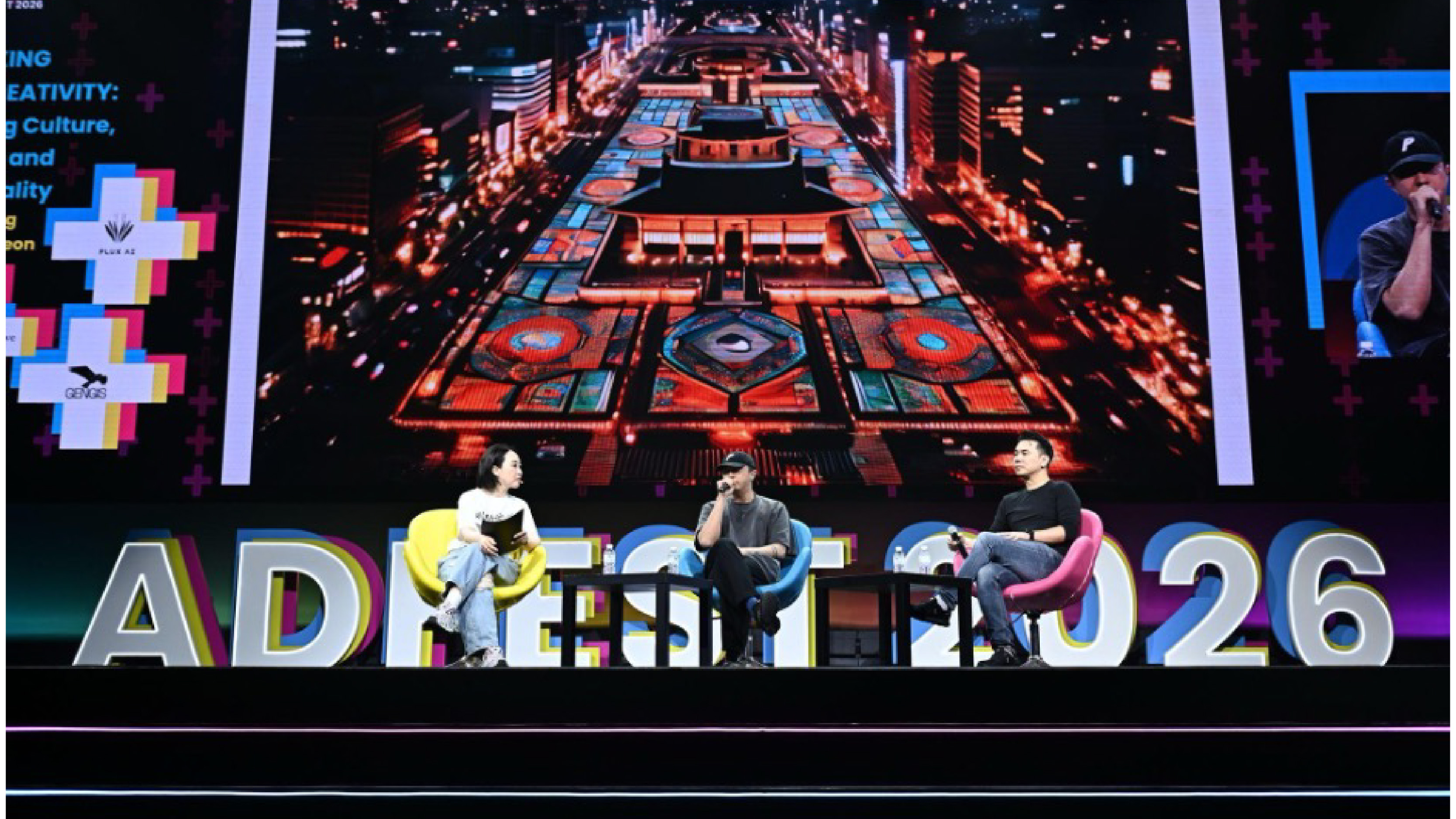
At adfest 2026, Julie Jihyun Kang, CEO of Flux AI Asia, Director Ian Tae Woong Jeon of Compound Collective and Applebox Asia, and Joel Lim, Founder and CEO of Gengis AI, presented “AI Unlocking Human Creativity: Redesigning Culture, Production, and Creative Reality.” to explore how artificial intelligence is transforming creative production — and why the human perspective may be its most valuable ingredient.
Kang opened with a question that shaped the discussion: when AI generates the work, does the result still match what its creator intended?
Kang sees that question becoming harder to answer as AI tools multiply. She counted more than 5,000 available tools, with new models and features emerging every day, yet creators have less clarity, control and consistency. She introduced Flux AI Asia’s Craisee as a platform designed to help creators maintain consistency between their original vision and the final output.
Jeon shared his decision making as a Director with the use of AI:
Find the right sound: His team works with composers instead of settling for library music. Previously, AI music was not good enough for their projects; now they use it with composers, guided by Jeon’s taste.
Look beyond generated references: When developing an idea, Jeon often closes the laptop. AI offers a vast mood board that others can access too. Walks, galleries and books give him textures and details to bring back to the work.
Examine the finished frames: AI images can look convincing until someone checks the details. His team reviews work frame by frame to find mistakes and inconsistencies. “Good quality comes from efficiency. Great quality comes from inefficiency,” he added.
“Shared visual certainty” was Kang’s description of what AI previsualisation gives a production team. Lim highlighted how AI-driven pre-visualisation can compress weeks of traditional concept work into days..
Lim further expanded on how the ability to pre-visualise greatly changes risk on both sides:
Reducing Financial Risks: Pre-productions can avoid overspending by testing environments and scenes virtually before committing physical budgets.
Increasing Creative Risks: present ambitious ideas because clients can visualise and imagine the concepts.
AI is expanding who can make content and what they can produce. Kang showed a Korean creator animating characters from a popular cooking programme and another making imagined behind-the-scenes footage for films including Titanic and Home Alone. Jeon compared the power now available to creators with handing a Formula 1 car to an elementary school child. It is exciting and unsettling, and it removes familiar excuses about budget, location and talent. Lim suggested that more creators could soon work with the equivalent of a “million-dollar budget.”
Lim also highlighted how AI has made possible the creation of environments that have redefined virtual production reducing weeks of work into minutes.
More production options put greater demands on people and human intuition. Jeon stressed that creatives need to understand how AI tools work, as well as their strengths, and limitations. We must also know when to step away from the tools and regain perspective. He further warned that as AI makes it easier for everyone to generate creative work, the role of the creatives become more important precisely because there will be so much more content to navigate.
Kang closed by asking colleagues to turn the opening of Albert Camus’ The Stranger into AI video. Each imagined a different scene from the same sentence. Kang saw a coffin floating above a village church; one colleague saw a man in a desert, and another a storm at sea. Given the sentence without anyone’s interpretation, AI produced a literal image of a dead person in a room. Kang used the experiment to make her closing point: “Our intent is the most powerful tool.”
Human intuition, intentional risk-taking, and uncompromising creative intent are not just here to stay—they are more vital than ever.
adfest is now calling for program proposal submissions. For your chance to take the stage at adfest 2027, submit your proposal here by 30 November. For more information on proposal submission, click here.