You don’t immediately think about craft when you see something like the Sphere in Las Vegas. You think big, awestriking - maybe even a bit too much. But sitting in this session, it becomes clear very quickly that none of that works without something far less visible - precision. Because when your “screen” wraps around 18,000 people, even the smallest decision stops being small.
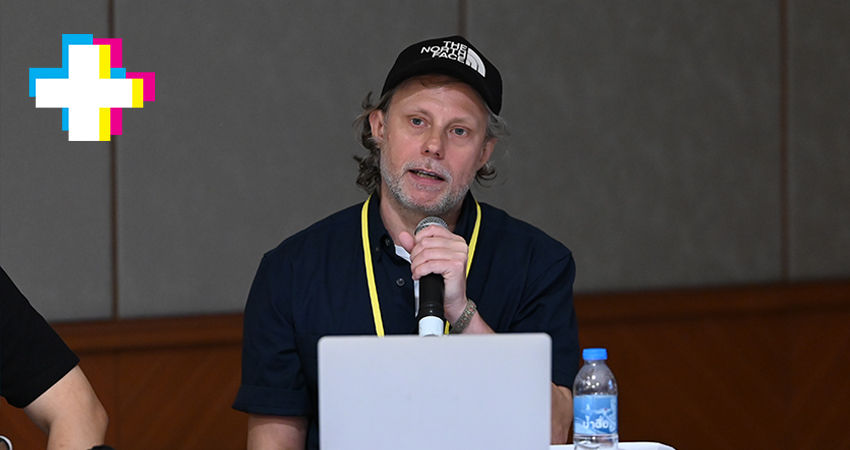
That was the underlying message from ADFEST 2026’s workshop, Built for The Big Screen: Crafting Human+ Visuals for Massive Performance Spaces, led by Michał Dwojak-Hara of Juice, Tokyo, and Fabian Tan of Dandelion Studios, Singapore.
While the visuals themselves are undeniably spectacular, what really drives this work isn’t just big ideas - it’s execution. At this scale, craft becomes everything, because scale fundamentally changes the rules.
But before any of that craft comes into play, the starting point is surprisingly simple - what should the audience feel? As the speakers put it, “Emotion comes first. Information comes second.”
In a space like the Sphere, the audience isn’t simply watching a screen - they’re inside it. And that introduces a challenge most creatives rarely have to think about. The human eye only sees a small area sharply at any one time, while the brain stitches the rest together. So no matter how large or detailed the screen becomes, people are only ever focusing clearly on a fraction of it.
At the same time, the audience is free to look wherever they want. Unlike traditional cinema, where the frame controls attention, immersive environments shift that control to the viewer. Or as the session put it, “In immersive environments, the audience choose where to look.”
That changes the role of the director entirely. You’re no longer directing shots - you’re directing attention. One of the clearest lines from the session captured it perfectly: “We design attention, not frames.”
And attention, in this world, has to be guided through the fundamentals of perception - motion, brightness, contrast, human figures, and directional cues. Movement pulls the eye. Light redirects focus. Contrast creates visual hierarchy. Even simple changes in scale or illumination can shift where thousands of people look at the same time.
That clarity of intent leads to another principle the speakers kept returning to - “Big screens need simple ideas.”
Not a campaign message. Not a dense narrative. A spatial idea.
Something strong enough to hold an entire environment together and simple enough to stay coherent across a 360-degree experience. Because at this scale, complexity does not create richness, it creates noise.
This was one of the most useful takeaways from the workshop. When the environment becomes too busy, the brain starts to struggle. People either ignore most of the content, focus on random parts of it, or simply become overwhelmed. That is why large immersive visuals often work better when they are built around one strong concept, clear motion, and a simple visual structure.
The Sphere’s 160,000 square feet of LED doesn’t just expand the canvas, it removes the frame entirely. There’s no fixed composition, no single viewpoint, and no guaranteed sequence of attention. Traditional editing becomes less useful. Instead of cuts, transitions are created through shifts in movement, light, scale, and environment.
In that sense, one of the workshop’s most memorable lines was also one of its simplest - “Motion is the director.”
That idea really sits at the center of the craft. Motion becomes a kind of visual gravity, pulling the eye through space. Rhythm replaces editing. Instead of a fast-cut sequence, immersive storytelling works more like music - build, release, transition, pause.
The examples shown, including the Backstreet Boys’ Into The Millennium residency and Anyma’s The End of Genesys, also made clear just how much technical work sits behind this apparent simplicity. Resolution, simulation, rendering, playback, file transfer, review cycles - everything becomes more demanding at this scale. Even normal design habits can break. Something as subtle as film grain, barely noticeable on a standard screen, can suddenly appear enormous and distracting when blown up to Sphere size.
And because creators often cannot fully preview the final experience at scale, the process becomes a constant loop of testing, feedback, and adjustment. What looks right on a monitor may behave very differently in the actual environment.
That is why one of the most forward-looking ideas in the session was about process, not just output. The CG and technical teams need to enter much earlier, even at concept stage, because in immersive media the brief itself has to change. As the speakers said, “The brief is not describing the film, it’s describing the human experience.”
That may be the biggest shift of all.
Instead of beginning with scenes and shots, the process begins with a feeling. What should people experience? Where should their attention go? How should the room move emotionally and visually over time?
Only then can the craft begin.
And even then, the answer is not to add more. It is usually to reduce. One emotional direction. One spatial idea. One system of movement, light, and rhythm that can guide the audience without overwhelming them.
That is also where the “Human+” theme feels most relevant. Not because technology takes over the creative process, but because it expands what human judgment can do. Technology enables the scale, but it is still people - through clarity, restraint, and craft - who determine whether the experience actually works.
For creatives, it means thinking less in frames and more in space. For producers, it means integrating execution much earlier in the process. And for both, it reinforces a simple truth - emotion may come first, but it is craft, clarity, and direction that carry the experience all the way through